Tests
Certified | accredited research
Physical-chemical testing

We hold the Good Laboratory Practice Compliance Certificate No. 11/2025/GLP in the fields of: physical-chemical testing, studies on the behaviour of the tested substance in water, soil and air, bioaccumulation studies, residue studies (analytical phase), other studies: chemical analysis.
Physical-chemical testing
| Determination of the density of liquids and solids | CIPAC MT 3 EC A.3 |
| Determination of pH values | CIPAC MT 75.3 |
| Acidity/alkalinity | CIPAC MT 191 |
| Determination of kinematic viscosity and calculation of dynamic viscosity | OECD 114 |
| Determination of apparent viscosity using the Brookfield method | OECD 114 |
| Storage of chemical substances and chemical preparations at a controlled temperature of 20±2℃ | GIFAP No. 17 |
| Accelerated aging test | CIPAC MT 46.4. |
| Storage of chemical substances and preparations at low temperatures and assessment of their physical stability | CIPAC MT 39.3 |
| Determination of durability of diluted plant protection products forming solutions with water | CIPAC MT 41.1 |
| Pourability of suspension concentrates | CIPAC MT 148.1; 148 |
| Determination of wettability | CIPAC MT 53.3 |
| Methods of determining the stability of aqueous suspensions | CIPAC MT 184.1 |
| Determination of the stability of emulsions and water suspo-emulsion | CIPAC MT 36.3; 180 |
| Determination of foaming | CIPAC MT 47.3 |
| Determination of bulk density loose and tapped | CIPAC MT 186 |
| Grain size determination of granular materials by dry method | CPAC MT 170 |
| Grain size determination by the wet method | CPAC MT 185 |
| Determination of solubility of packaging in water | CPAC MT 176; 18 |
| Packaging test | Crop Life Inernational. Technical Monograph No 17 |
| Test of efficiency of packaging washing | Efficacy Guideline 305 |
| Appearance and physical state | OPPTS od 830.6302 do 04 |
| Determination of particle size distribution | OECD 110 CIPAC MT 187 |
| Determination of the Spontaneity Dispersion | CIPAC MT 174; 160 |
| Determination of Granular Product Dust Content | CIPAC MT 171.1 |
| Determination of seed treatment distribution uniformity and adhesion | CIPAC MT 175 |
| Attrition resistance and friability | CIPAC MT 178.2 |
| Physical compatibility of pesticides | ASTM E1518 |
| Determination of the adhesion agent on seeds | CIPAC MT 194, 175 |
| Determination of surface tension of aqueous solutions | EC A. 5 |
| Determination of solubility of chemicals substances | EC A. 6 |
| Partition coefficient n-octanol/water: shake flask method | OECD 107 |
| Determination of pour points | EC A.1 |
| Determination of melting point of chemical substances | EC A.1 |
| Determination of boiling point of chemical substances | EC A.2 |
| Determination of organic carbon | Shimadzu Analyser |
Physical-chemical testing
Physicochemical tests of hazardous materials.
Physical-chemical testing
| Determination of vapor pressures of substances using static method | OECD 104 |
| Testing corrosive effects on metals: a test for determining the corrosive properties of liquids and solids that may become liquid during transport | Manual of Tests and Criteria, Seventh revised edition ST/SG/AC.10/11/Rev.7. United Nations, New York and Geneva, 2019 – Section 37 Classification procedures, test methods and criteria relating to substances corrosive to metals, Test C.1. |
| Determination of oxidising properties of solids | Test UN O.1 |
| Determination of oxidizing properties of liquids | Test UN O.2 |
| Determination of the auto-ignition temperature of substances (liquids and gases) | PN-EN ISO/IEC 80079-20-1:2020-03 |
| Flammability – solid | Test UN N.1 |
| Determination of flash point by the Pensky-Martens closed-cup method | PN-EN ISO 2719:2016 |
| Determination of flash point by the Abel closed-cup method | PN-EN ISO 13736:2021 |
| Determination of ignition or non-ignition and flash point temperature using a rapid equilibrium method in a closed crucible | PN-EN ISO 3679:2023 |
| Determination of the boiling temperature of substances by DSC and TG methods | EC A.2 OECD 103 |
| Determining specific heat by DSC method | OECD 114 |
Contact
Michał Frączak, MSc Eng.
e-mail: michal.fraczak@ipo.lukasiewicz.gov.pl
Telephone: +48 22 88 41 350
Physical-chemical testing
Determination of explosive properties.
Testing of physicochemical, thermal and explosive properties
| Determination of the explosive properties of substances, chemical preparations, and plant protection products: • Determination of impact sensitivity • Determination of friction sensitivity • Determination of thermal sensitivity according to EC A.14 |
|---|
| Internal ignition test |
| Thermal stability test 48/75 |
| Small-scale combustion test |
| Determination of the detonation resistance of simple nitrogen fertilizers with high nitrogen content containing ammonium nitrate (field test) |
| Determination of decomposition temperature |
| Detonation velocity determination |
| Gap test (GAP test) |
| Thermal stability testing of matrices |
| Pyrostatic testing of gunpowder |
| Determination of the chemical stability of propellants anf gunpowder using the Vieille method |
| Designation of combustion heat (under reduced pressure) |
| Linear combustion rate microengine combustion method |
| Determination of moisture content of black powder |
| Stationary research on rocket engines |
| Thermal analysis (DSC, DTA) |
| Thermomechanical analysis (DMA) |
| Chemical and thermal stability tests (heat flow calorimeter – HFC) |
| Compatibility/Contact Compatibility Testing (DSC, VST) |
Contact
Katarzyna Gańczyk-Specjalska, PhD
e-mail: katarzyna.ganczyk-specjalska@ipo.lukasiewicz.gov.pl
Telefon: +48 22 88 41 306, +48 605 534 503
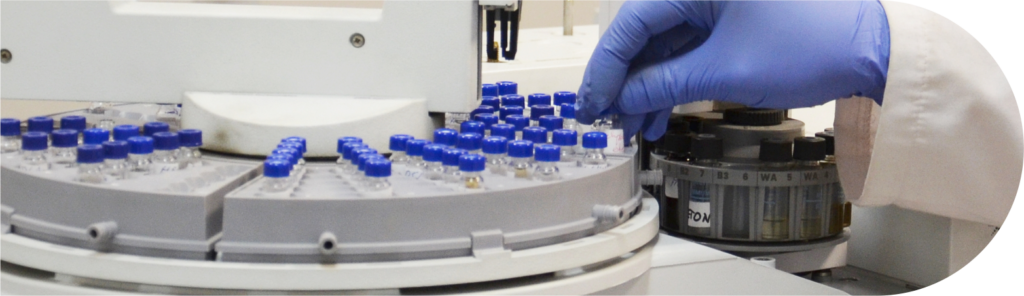
Analytical studies
Analytical studies
| Determination of active substance content and significant impurities using GC and HPLC techniques | wg SANCO/ 3030/99 rev.5 |
| Determination of substance content by potentiometric titration | Titroline apparatus |
| Determination of free phenols content | CIPAC MT 69.1-2 |
Contact
Anna Kiełczewska, MSc Eng.
e-mail: anna.kielczewska@ipo.lukasiewicz.gov.pl
Telefon: +48 22 88 41 295
Biodegradability test

Biodegradability test
| Ready aerobic biodegradability screening test of substances in an aerobic aquatic environment using manometric respirometry | OECD 301 |
| Ready aerobic biodegradability screening test of substances in an aerobic aquatic environment using the closed bottle method | OECD 301 |
Toxicological studies

The studies are conducted under the Good Laboratory Practice quality system (Certificate No. 10/2024/GLP) according to methods: OECD, EU, SCCS, ISO, EMA, FDA, and their results are used for registration purposes, licensing, as well as other regulations in the field of industrial chemicals.
We hold Good Laboratory Practice certificates and full accreditation from AAALAC International, granted by the Association for Assessment and Accreditation of Laboratory Animal Care (AAALAC) International Council. This accreditation confirms adherence to the highest standards in ensuring the welfare of laboratory animals.
In vitro, ex vivo, in vivo eye corrosion/ irritation studies
| Isolated chicken eye test method for identifying I) chemicals inducing serious eye damage, II) chemicals not requiring classification for eye irritation or serious eye damage. | OECD Nr 438 |
| Short time exposure in vitro test method for identifying I) chemicals inducing serious eye damage II) chemicals not requiring classification for eye irritation or serious eye damage. | OECD Nr 491 |
| The test method used within the study on the model of reconstructed human cornea-like epithelium (RhCE), used for identifying chemicals not requiring classification and labelling for eye irritation or serious eye damage. | OECD Nr 492 |
| Reconstructed human cornea-like epithelium (RHCE) test method for eye hazard identification. | OECD Nr 492B |
| Acute eye irritation/ eye corrosion test. | OECD Nr 405/EU B.5 |
In vitro, ex vivo, in vivo skin corrosion/ irritation studies
| In vitro skin corrosion: transcutaneous electrical resistance test (TER) | OECD Nr 430/EU B.40 |
| In vitro skin corrosion: reconstructed human epidermis (RHE) test method. | OECD Nr 431/EU B.40 |
| In vitro skin irritation. The test on the model of reconstructed human epidermis. | OECD Nr 439 |
| Acute skin irritation/ corrosion test. | OECD Nr 404/EU B.4 |
| Biological evaluation of medical devices – Test for skin irritation in vitro. | ISO 10993-23 |
In vitro, in chemico, in vivo skin sensitisation studies
| Skin sensitisation: local lymph node assay (LLNA): BrdU-ELISA. | OECD Nr 442B |
| In chemico skin sensitisation, direct peptide reactivity assay (DPRA). | OECD Nr 442C/EU B.59 |
| In vitro skin sensitisation: the test method with use of ARE-Nrf2 Luciferase. | OECD Nr 442D |
| In vitro skin sensitisation: Human cell line activation test (H-CLAT). | OECD Nr 442E |
| Skin sensitisation study. | OECD Nr 406/EU B.6 |
| Delayed hypersensitivity assessment test using the closed-patch method (Buehler Test). | ISO 10993-10 |
In vitro cytotoxicity studies
| In vitro cytotoxicity test. | ISO 10993-5 |
In vitro phototoxicity
| Phototoxicity – In vitro 3T3 NRU phototoxicity test. | OECD Nr 432 |
| In vitro Phototoxicity – Reconstructed Human Epidermis Phototoxicity test method. | OECD Nr 498 |
In vitro Pyrogen Test
| Monocyte Activation Test | ISO/ Farmakopea |
In vitro, in vivo studies identifying endocrine-disrupting substances
| Stably Transfected Human Estrogen Receptor-α Transactivation Assay for Detection of Estrogenic Agonist and antagonist Activity of Chemicals using the hERα-HeLa-9903 cell line. | OECD Nr 455 |
| Uterotrophic Bioassay in Rodents A short-term screening test for oestrogenic properties. | OECD Nr 440 |
| Hershberger bioassay in rats. Short-term screening test of (anti-) androgenic properties. | OECD Nr 441 |
| H295R Steroidogenesis Assay | OECD Nr 456 |
In vitro, in vivo acute toxicity
| Use of the 3T3 neutral red uptake cytotoxicity test to estimate starting doses for acute oral systemic toxicity tests. | OECD Series on Testing and Assessment No. 129 (2010) (ENV/JM/MONO(2010)20) |
| Acute oral toxicity test. | OECD Nr 420/EU B.1 BIS |
| Acute oral/ intraperitoneal/ subcutaneous/ intravascular toxicity test - acute toxic class method | OECD Nr 423/EU B.1 TRIS |
| Acute dermal toxicity test. | OECD Nr 402/EU B.3 |
| Acute inhalation toxicity test. | OECD Nr 403 |
| Acute inhalation toxicity – acute toxic class method. | OECD Nr 436/EU B.52 |
| Maximum tolerated dose test (MTD). | |
| Single dose toxicity study in rodents. | ISO 10993-11 |
In vivo subacute, subchronic and chronic studies
| Dose range finding test (DRF). | |
| Repeated dose 28-day oral/ intraperitoneal/ subcutaneous toxicity study in rodents. | OECD Nr 407/EU B.7 |
| Repeated dose dermal toxicity: 21/ 28 day study. | OECD Nr 410/EU B.9 |
| Repeated dose 90-day oral toxicity study in rodents. | OECD Nr 408/EU B.26 |
| Subchronic dermal toxicity: 90-day study. | OECD Nr 411/EU B.28 |
| Chronic toxicity studies. | OECD Nr 452/EU B.30 |
| Combined chronic toxicity/ carcinogenicity studies. | OECD Nr 453/EU B.33 |
In vivo neurotoxicity studies
| Neurotoxicity study in rodents. | OECD Nr 424/EU B.43 |
In vivo developmental and reproduction studies
| Prenatal developmental toxicity study. | OECD Nr 414/EU B.31 |
| Reproduction/ developmental toxicity screening test | OECD Nr 421 |
| Combined repeated dose toxicity study with the reproduction/ developmental toxicity screening test. | OECD Nr 422 |
| Extended one-generation reproductive toxicity study in rats. | OECD Nr 443/EU B.56 |
| Two-generation reproduction toxicity study. | OECD Nr 416/EU B.35 |
In vitro, in vivo genotoxicity studies
| Bacterial reverse mutation test (AMES test, microplate format). | based on OECD Nr 471/ EU B.13/14 |
| In vitro micronucleus test on the mammalian cell line. | OECD Nr 487 |
| In vitro mammalian cell gene mutation tests using the HPRT genes. | OECD Nr 476 |
| In vivo mammalian erythrocyte micronucleus test. | OECD Nr 474/EU B.12 |
| In vivo mammalian cell gene mutation test using the thymidine kinase gene. | OECD Nr 490/EU B.67 |
| In Vivo Mammalian Alkaline Comet Assay. | OECD Nr 489 |
In vivo carcinogenicity studies
| Carcinogenicity study | OECD Nr 451/EU B.32 |
| Combined chronic toxicity/ carcinogenicity studies. | OECD Nr 453/EU B.33 |
In vivo local tolerance studies
| Local tolerance test. | CPMP/SWP/2145/00, ISO 10993-10 |
Toxicokinetics/pharmacokinetics study.
| Badanie toksykokinetyki (część doświadczalna na szczurach) | OECD Nr 417/EU B.436 |
Other services
| Toxicological studies conducted according to the procedures agreed with the customer |
| Haematological studies |
| Biochemical studies |
| Hormone identification |
| Tissue and organ collection |
| Preparing histopathology slides and their scanning |
Contact
Katarzyna Winiarska, MSc
e-mail: katarzyna.winiarska@ipo.lukasiewicz.gov.pl
Telephone: +48 32 210 30 81 ext. 123, +48 885 387 000 150
Ecotoxicological studies

The studies are conducted under the Good Laboratory Practice quality system(Certificate No. 15/2025/GLP) according to methods: OECD, EU, ISO, EPA, SANTE, SANCO, SETAC, ESCORT 1, ESCORT 2, IOBC, BART, EPPO, and the results are used for registration, licensing as well as other regulations in the field of industrial chemicals.
Aquatic toxicity studies
| Freshwater algae and cyanobacteria, growth inhibition test. | OECD Nr 201/EU C.3 |
| Lemna sp. growth inhibition test. | OECD Nr 221/EU C.26 |
| Sediment–free Myriophyllum spicatum toxicity test. | OECD Nr 238 |
| Water–sediment (Myriophyllum spicatum) macrophytes spicatum toxicity test. | OECD Nr 239 |
| Daphnia magna., acute immobilisation test. | OECD Nr 202/ EU C.2 |
| Daphia magna. reproduction test. | OECD Nr 211/EU C.20 |
| Sediment–water chironomid toxicity using spiked sediment. | OECD Nr 218/EU C.27 |
| Sediment–water chironomid toxicity using spiked water. | OECD Nr 219/EU C.28 |
| Sediment–water chironomid life-cycle toxicity test using spiked water or spiked sediment. | OECD Nr 233/ EU C.40 |
| Chironomus sp., acute immobilisation test. | OECD Nr 235 |
| Fish Cell Line Acute Toxicity – The RTgill-W1 cell line assay. | OECD Nr 249 |
| Fish embryo acute toxicity (FET) test. | OECD Nr 236 |
| Fish, acute toxicity test. | OECD Nr 203/EU C.1 |
| Fish, early-life stage toxicity test. | OECD Nr 210 |
| Fish, short-term toxicity test on embryo and sac-fry stages. | OECD Nr 212/EU C.15 |
| Fish, juvenile growth test. | OECD Nr 215/EU C.14 |
| Bioaccumulation in fish: aqueous and dietary exposure. | OECD Nr 305/EU C.13 |
| 21-day fish assay: a short-term screening for oestrogenic and androgenic acitivity in zebrafish. | OECD Nr 230/EU C.37 |
Toxicity studies for soil organisms
| Terrestrial plant test, seedling emergence and seedling growth test. | OECD Nr 208 |
| Terrestrial plant test, vegetative vigour test. | OECD Nr 227 |
| Earthworm, acute toxicity test. | OECD Nr 207/ EU C.8 |
| Earthworm, reproduction test. (Eisenia fetida/Eisenia andrei) | OECD Nr 222 |
| Collembolan, reproduction test in soil. (Folsomia candida) | OECD Nr 232 |
| Predatory mite Hypoaspis (Geolaelaps), reproduction test in soil. | OECD Nr 226 |
| Soil microorganisms: nitrogen transformation test. | OECD Nr 216/ EU C.21 |
| Soil microorganisms: carbon transformation test. | OECD Nr 217/ EU C.22 |
Toxicity tests for pollinators and beneficial arthropods
| Honeybees, acute oral toxicity test (Apis mellifera) | OECD Nr 213/ EU C.16 |
| Honeybees, acute contact toxicity test (Apis mellifera) | OECD Nr 214/ EU C.17 |
| Honeybees, larval toxicity test (Apis mellifera) – single exposure | OECD Nr 237 |
| Honeybees, larval toxicity test (Apis mellifera) – repeated exposure. | OECD GD 239 |
| Honeybees (Apis mellifera), chronic oral toxicity test (10-day feeding). | OECD Nr 245 |
| Study of honeybees' flight ability to return to the hive after a single oral exposure to sublethal doses of chemicals. | OECD GD 332 |
| Bumblebees (Bombus spp.), acute oral toxicity test. | OECD Nr 247 |
| Bumblebees (Bombus spp.), acute contact toxicity test. | OECD Nr 246 |
| A laboratory test or extended laboratory test for evaluating the effects of plant protection products on the parasitic wasp, Aphidius rhopalosiphi De Stephani-Perez. | SETAC; ESCORT 1, ESCORT 2; IOBC/BART/EPPO |
| A laboratory test or extended laboratory test for evaluating the effects of plant protection products on the predatory mite, Typhlodromus pyri Scheuten. | SETAC; ESCORT 1, ESCORT 2; IOBC/BART/EPPO |
| A laboratory test for evaluating the effects of plant protection products on the spider, Pardosa. | SETAC; ESCORT 1, ESCORT 2; IOBC/BART/EPPO |
| A laboratory test or extended laboratory test for evaluating the effects of plant protection products on the seven spotted ladybird beetle, Coccinella septempunctata L. | ESCORT 1, ESCORT 2, IOBC, BART, EPPO |
| A laboratory test or extended laboratory test for evaluating the effects of plant protection products on the green lacewing, Chrysoperla carnea. | ESCORT 1, ESCORT 2, IOBC, BART, EPPO |
| Aged residue test on the parasitic wasp, Aphidius rhopalosiphi De Stephani-Perez. | ESCORT 1, ESCORT 2, IOBC, BART, EPPO |
| Aged residue test on the predatory mite, Typhlodromus pyri Scheuten. | ESCORT 1, ESCORT 2, IOBC, BART, EPPO |
| Aged residue test on the seven spotted ladybird beetle, Coccinella septempunctata L. | ESCORT 1, ESCORT 2, IOBC, BART, EPPO |
| Aged residue test on the green lacewing, Chrysoperla carnea. | ESCORT 1, ESCORT 2, IOBC, BART, EPPO |
| A test for evaluating the chronic effects of plant protection products on the rove beetle Aleochara bilineata (Coleoptera: Staphylinidae) | SETAC; ESCORT 1, ESCORT 2; IOBC/BART/EPPO |
| A method for testing effects of plant protection products on the carabid beetle Poecilus cupreus (Coleoptera, Carabidae) | SETAC; ESCORT 1, ESCORT 2; IOBC/BART/EPPO |
Fate and behaviour in the environment
| Ready biodegradability: closed bottle | OECD Nr 301D/ EU C.4-E |
| Ready biodegradability: manometric respirometry | OECD Nr 301F/ EU C.4-D |
| Inherent biodegradability: Zahn-Wellens/ EMPA test | OECD Nr 302B/ EU C.9 |
| Activated sludge, respiration inhibition test | OECD Nr 209/EU C.11 |
| Aerobic and anaerobic transformation in soil | OECD Nr 307/EU C.23 |
| Leaching in soil columns | OECD Nr 312 |
| Development and validation of an analytical method in water, soil, sediments and plant and animal materials | SANTE/2020/12830 |
| Determination of the residues of chemical substances in water, soil, sedimemt, plant and animal materials | SANTE/2020/12830 metoda własna |
| Stability of pesticide residues in stored commodities | OECD Nr 506 |
| Bioaccumulation in Terrestrial Oligochaetes | OECD Nr 317 |
Physical and chemical properties
| Water solubility | OECD 105/EU A.6 |
| Solubility in organic solvents | CIPAC MT 181 |
| Adsorption – desorption using batch equilibrium method | OECD 106/EU C.18 |
| Partition coefficient (n-octanol/water): shake flask method | OECD 107/EU A.8 |
| Hydrolysis as a function of pH | OECD 111/EU C.7 |
| Partition coefficient (n-octanol/water), HPLC method | OECD Nr 117 |
| Estimation of the adsorption coefficient (KOC) on soil and on sewage sludge using high performance liquid chromatography (HPLC) | OECD 121/EU C.19 |
Ecosystem structure study
| Simulated freshwater lentic field test (outdoor microcosms and mesocosms) | OECD GD 53, ENV/JM/MONO(2006)17 |
Contact
Katarzyna Winiarska, MSc
e-mail: katarzyna.winiarska@ipo.lukasiewicz.gov.pl
Telephone: +48 32 210 30 81 ext. 123, +48 885 387 000 150
Testing for hazardous properties of materials
Testing field:
- Chemical testing (C)
- Electrical and electronical testing (E)
- Physical testing (N)
Objects:
- Chemical products
- Construction products, materials and structures
- Fuels
- Others products
- Personal protective equipment
- Textiles and leather
- Wastewater
- Fertilizers
- Paints and varnishes
- Explosives and ammunition
Contact
Małgorzata Wróblewska-Piotrowska, MSc, Eng.
e-mail: malgorzata.wroblewska@ipo.lukasiewicz.gov.pl
Telefon: +48 22 88 41 373